


Prosthesis Dental Implant: What Is It? Is It Right For You?
- Sep 22, 2025
- 3 min read
Updated: Jul 7
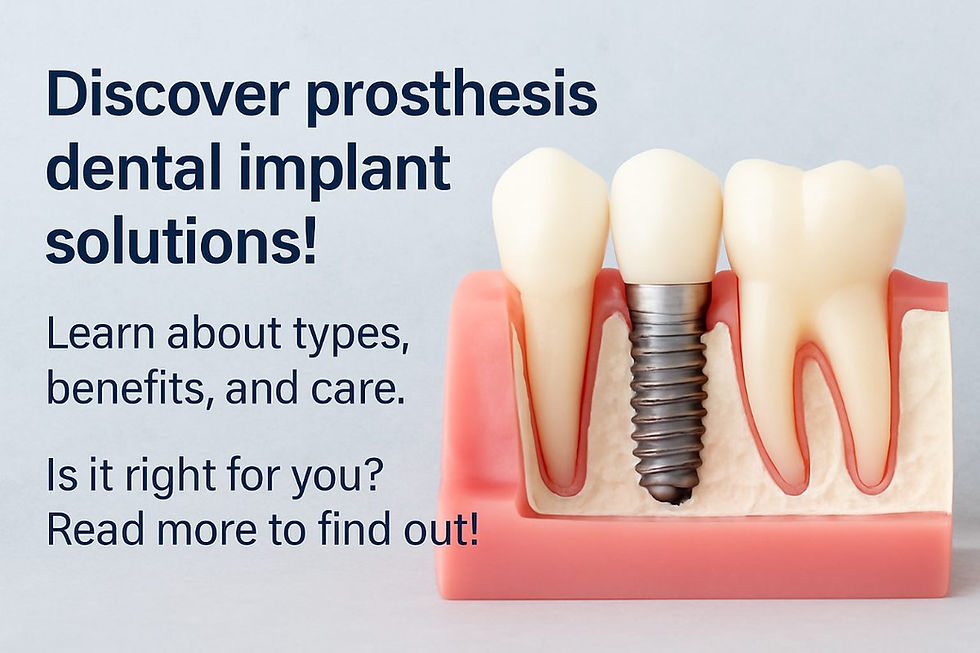
A prosthesis dental implant replaces missing teeth with a prosthetic tooth or set of teeth anchored to a dental implant. People who lose one or more teeth from decay, injury, or wear often consider this option. In this short guide you’ll learn what a prosthesis dental implant is, the common types, benefits and risks, basic care, and how to find out if it’s right for you.
What is a prosthesis dental implant?
A prosthesis dental implant has three main parts: the implant, the abutment, and the prosthesis. The implant is a titanium post placed into the jawbone. The abutment connects the implant to the prosthesis. The prosthesis can be a single crown, an implant-supported bridge, or a denture that attaches to one or more implants.
The prosthesis attaches securely to the implant via the abutment or special clips/screws. Unlike a natural tooth, the implant does not have a ligament; it fuses directly to bone (osseointegration). That makes it very stable but different in feel from a tooth with a natural ligament.
Common types of prosthesis dental implant solutions
Single-tooth prosthesis
Used when one tooth is missing. A single implant and crown replace the tooth, restoring chewing and appearance with a result that looks like a natural tooth.
Implant-supported bridge
When two or more adjacent teeth are missing, an implant-supported bridge uses implants at each end to carry a multi-tooth prosthesis. It replaces several teeth without placing an implant for every missing tooth.
Full-arch prosthesis (implant-supported denture / All-on-4)
For patients missing most or all teeth, a full-arch prosthesis (such as All-on-4) uses several implants to support a complete set of teeth. This option offers strong stability and is common for patients who want fixed, long-term replacement. Many people seek a full-arch prosthesis dental implant San Antonio when they need full-mouth restoration.
Benefits, risks, and maintenance
Benefits: Better chewing function, preserved jawbone, improved appearance, and long-term durability.
Risks/considerations: Requires surgery and healing time, possible need for bone grafting, risk of infection or implant failure, and higher upfront cost compared with removable dentures.
Basic care steps include regular brushing and flossing, cleaning around the abutments, and routine dental checkups. With good care, many prostheses last 10–20 years or longer, though parts like crowns or denture teeth may need replacement sooner.
Is a prosthesis dental implant right for you?
Factors to consider include your overall oral health, jawbone volume, chronic medical conditions (like diabetes), smoking status, budget, and timeline for treatment. Good bone and healthy gums make implants more predictable. Smoking and uncontrolled health issues can raise the risk of complications.
At a consultation you can expect an exam, dental X-rays or a CBCT scan, a review of your medical history, and a personalized treatment plan with a cost estimate and timeline. The plan will explain whether you need bone grafts, the number of visits, and sedation options if you prefer them.
The Smile Institute SA evaluates candidacy carefully, using digital imaging, an on-site laboratory, and options like IV sedation and financing to make care easier. Dr. Luis Galvan and the team focus on clear communication and personalized plans for prosthesis dental implant San Antonio candidates.
If you’re ready to learn whether a prosthesis dental implant San Antonio is right for you, schedule a consultation with our San Antonio office to get a full exam, imaging, and a written treatment plan.


Comments